

-
Becoming a Pilot
-
Already a Pilot
-
Flight Instructor
- Pro / Turbine
- Aviation Maintenance
- Aviation Educators
- Why Choose King Schools


The History and Future of King Schools
THE HISTORY OF KING SCHOOLS
When John and Martha married in 1965, they decided to work together in business and be “equal partners in everything they would do.” John’s line is, “it has been over 50 years now and I am still struggling to be Martha’s equal partner.”
King Schools was started and grew as John and Martha together pursued their twin passions for entrepreneurship and flying.
In September 1974, they started teaching small ground school classes for local flight schools.
In 1975 they began sending out mailers to pilots around selected cities and setting up classes in hotel meeting rooms.
Over time they developed a business of teaching ground school classes in a single weekend for a circuit of cities in the upper Great Plains and the Northwest, where learning pilots otherwise had to make long drives to attend regular weekly ground school sessions.
John and Martha frequently selected hotels with pools, which a learning pilot’s family could enjoy during the weekend while the Kings taught the classes on Saturday and Sunday. In one meeting room, John taught Private, Commercial, and Flight Instructor courses. In the other meeting room, Martha taught Instrument and Instrument Flight Instructor courses. On Monday, they made a meeting room available for the FAA-administered written exams.
The Kings had a policy that once someone had attended their in-person classes, that person could re-attend as many times as they wanted for free. This worked out to be a good business policy because re-attendees would often bring friends with them who would pay to attend. As a result, as time progressed classes at each location would get bigger and bigger.
They taught their weekend classes 50 weekends a year for 10 years and in the process greatly fine-tuned their presentations. Teaching an entire ground school course in one weekend with a test on Monday required very efficient teaching. They had to get started in subjects smoothly. They used mnemonics to help people visualize and remember concepts, and they used humor when appropriate to help make lasting memories.
In 1977 they upgraded their transportation to a Cessna 340, taking turns flying themselves on their circuit to teach the classes.
Since the Kings advertised their arrival for each class, local pilots would often arrange a party for them on arrival. The Kings got to know the pilots in each community well. Sadly, sometimes when the Kings returned to a community, they would learn that a local pilot had come to grief in an airplane. Most troubling was the recognition that the FAA written exams and the practical tests they were preparing pilots for did not cover the things that were causing the accidents. These often focused on relatively trivial knowledge and skills, while the accidents were caused by a failure in risk management so grave that no amount of skill could solve the problem.
Especially concerning was one case in which John felt a learning pilot was not following the conventions of a classroom. When John asked the FAA inspector who came to monitor the test to talk with the pilot about risk management, the inspector declined. The pilot was dead from an accident within two weeks.
The Kings were deeply troubled by this event—even questioning whether they wanted to continue teaching learning pilots. Eventually, they resolved that when they saw a situation where they could make a difference, they would not fail to put in the effort needed to remedy it. They eventually made the same resolution regarding the entire aviation community. The Kings developed a philosophy and standard operating procedures on the subject of risk management and frequently volunteered their time to speak on the subject.
In 1982 the technology of home video became widely available through VHS tape machines. The Kings started using video in the classroom to relieve their fatiguing personal workload. They delayed selling the videos under the belief that the great results they were getting in the classroom were the result of their personal presence.
In 1984, at the suggestion of customers, they began offering video courses to flight instructors for them to use to teach their own students.
During that time, they also enhanced their learning of direct marketing and further developed their marketing skills.
In 1985, they discovered at AirVenture that many of their sales were actually being made to individual learners rather than flight instructors, so they began marketing their video courses directly to learning pilots. The fact that they had taught over 500 ground school courses in person and had honed their presentations meant that the video presentations were fun and highly engaging, personable and effective for the customers. That fact, and their improved marketing skills, provided for exponentially expanded sales.
In 1987 they swapped their Cessna 340 for a Citation 500 jet. Their Citation required two pilots, and the Kings traded seats and pilot flying and pilot monitoring duties on each leg. The video they made of their crew coordination while flying the Citation became an insightful briefing for thousands of pilots upgrading from piston to jet aircraft.
In 1988 King Schools developed the technique of using chroma key, which allows an on-camera instructor to point and refer to video behind them while conducting the lesson. (This is the technique often used by the local TV weather person.) The benefit of chroma key to the viewer is the ability of the instructor to point directly at the item they are talking about rather than having the video completely replace them and having to talk about it off-screen. The use of chroma key requires considerable learning and skill from the on-camera instructor and is seldom, if ever, employed by instructors with other aviation course providers. King Schools has continued to use chroma key in their video instruction ever since 1988.
In 1995 King Schools began delivering FAA-style question review and test prep on CD-ROM to be taken on a personal computer. These questions, which were the first King School products to make use of a computer, were developed to accompany their widely popular video ground school courses on VHS tape.
In 1997 King Schools became the curriculum provider for the Cessna Pilot Center network, and greatly upgraded Cessna’s instruction programs with computer-played video.
In 1999 King video courses were incorporated into a computer program which was shipped on DVDs. The computer-played video was a technological breakthrough which allowed efficient computer display of the video, tracking of the learning pilot’s progress, and incorporated the FAA-style quizzing questions at the end of each video lesson. Plus, the DVDs were far handier than the VHS tapes, allowing learners to revisit topics directly without having to rewind or fast-forward tape.
By the end of the century, when comparing their sales in units with the number of pilots learning to fly, John and Martha discovered that through the technology of computer video they were teaching half of the pilots in the United States learning to fly.
In 2000 Microsoft came to John and Martha and asked, “Do you think you could make a video that would help people enjoy Microsoft Flight Simulator more and stay with the program longer?” They said, “We think we can,” and produced Flight Simulator 2000: Getting Started with John and Martha King. In the video, John excitedly flies the simulator while Martha explains the menus and how the program works. The video was translated into 7 languages and seen by millions around the world.
In 2001 John and Martha upgraded from the Citation to a Falcon 10. In the Falcon 10, which also requires two pilots, the Kings continue their policy of trading seats and pilot flying and pilot monitoring roles.
In 2004 they flew their Falcon around the world by way of Russia.
In 2005, using the knowledge they gained from that around-the-world trip, they launched the King Schools line of courses for professional pilots. The Reduced Vertical Separation Minimums (RVSM) course was the first King course available through a web browser over the internet. The internet delivery removed the requirement for learning pilots to install the programs on their own computers and made courses more quickly and conveniently available. The line of professional and turbine pilot courses expanded over time to more than 35 courses.
In 2011, when John was offered the opportunity to participate in an Aviation Rule-Making Committee (ARC) on the subject of how pilots should be evaluated, he jumped at it.
In 2012 John also eagerly joined up when the ARC was replaced by an Aviation Rulemaking Advisory Committee (ARAC) Working Group. The ARAC Working Group’s purpose was to change the practical tests from Practical Test Standards for skills to Aviation Certification Standards (ACS), which would include for the first time the requirement that pilots demonstrate the ability to identify and manage risks. Also to be included were standards for knowledge, to avoid the trivial knowledge questions of the past.
The Kings were thrilled to see these changes take place and doubled up on their volunteer talks on risk management. They also began writing a regular column in FLYING magazine on risk management.
In 2018 King Schools developed an iOS application to accompany the ground school and test prep courses. The application allows the courses to be taken on a mobile device without an internet connection. Anytime the device is connected to the internet it transfers the learning pilot’s course progress to the King servers to be available to the learner online.
Throughout their careers, John and Martha have each greatly enjoyed learning and participating in various types of flying. Consequently, they became the first (and only) couple to have every category and class of aircraft rating on their pilot and flight instructor certificates. (see KingSchools.com/meet-john-and-martha)
This may help to explain why in 2019 John and Martha became the first couple in history to be enshrined together in the prestigious National Aviation Hall of Fame.
In 2022 King Schools produced a second companion app. This app delivers flashcards and FAA-style questions as question reviews and practice tests the learner’s progress regardless of whether they are online or offline.
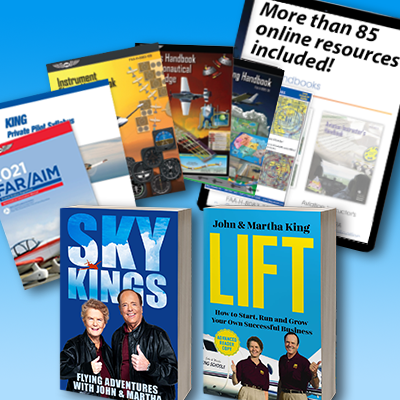
In 2022 the Kings published a book about their experiences and insights from starting and growing King Schools: LIFT—How to Start, Run, and Grow Your Own Successful Business. (see kingschools.com/lift-how-to-start-and-grow-your-own-successful-business)
In 2023 they published a second book, a compilation of their risk management columns from almost 10 years of writing for FLYING magazine: SKY KINGS—Flying Adventures with John and Martha. (see KingSchools.com/sky-kings)
Now, 50 years into the business, at airports and aviation events when pilots recognize and stop John and Martha, a line forms of pilots who want to get a picture with them and tell John and Martha about the profound effect they have had on their multiple family generations. Particularly touching are stories from airline pilots who tell of the profound effect on their lives from watching their father’s King videos when they were very young.
The Kings have become aware they have a significant positive influence in the worldwide aviation community as a result of their fun, engaging and personable teaching, made widely accessible through the use of technology and effective marketing.
THE FUTURE OF KING SCHOOLS
Today the Kings, while in good health and continuing to fly themselves in their Falcon 10, are “almost old enough to be President of the United States” 😊. They are structuring the company to move forward without them, as will inevitably be necessary.
Long-time pilot and flight instructor Barry Knuttila (see KingSchools.com/meet-Barry-Knuttila), who is also type-rated in the Falcon10, is now co-owner of King Schools, and as CEO, provides able, responsible and ethical command of the daily operations of the company. Barry, shares John and Martha’s vision of providing an exceptional customer experience to learning pilots, and actively directs the development of new technologies to enhance that experience.
Learning pilots will increasingly see Barry and other highly qualified flight instructors in addition to the Kings in the course videos.
It is the company’s goal to continue the long tradition of making learning clear, simple and fun and to give learning pilots an increasingly rich learning experience from King Schools.